
By Timothy Brantingham
As someone born and raised in Taiwan, but now living in Japan, I have been mesmerized by headlines recently appearing on my news feed:
LA Times: Taiwan Finds a Lot to Love About its Former Colonizer, Japan.
Japan Times: Taiwan is Where Japanese Tourists Go to Feel at Home.
The Diplomat: The Odd Couple: Japan and Taiwan’s Unlikely Friendship
There are many more…
I have always known, intellectually at least, that Taiwan was once a colony of Japan (1895-1945) and that there was a significant amount of Japanese influence on the island. Yes, the iconic Presidential Palace along with many of the old government buildings downtown were built by the Japanese. And sure, anyone over 65 may speak a little Japanese. But it seems the relationship is a lot deeper than I thought, and it has taken me living in Tokyo to really see it.
For instance, there’s my favorite Taiwanese street snack, delivered by a guy on a bicycle with a loud steel hammer tuck, tuck, tucking his much-anticipated arrival to my street. He served a wet, nugget-sized glob of sticky dough, covered in peanut powder, filled on the inside with sugar and sesame powder. In his thick Taiwanese accent, he called it muaa-ji. Holy cow—turns out that’s Japanese mochi.
Then there’s baseball, which I used to play outside my Shihlin house with the local neighborhood boys. Ou-to! I always assumed the sport was brought to the island by the US 7th Fleet post WW2. But no, it was brought to Taiwan by the Japanese in 1897, and was played first in Japanese government schools, and then in local ones soon after that. (Baseball arrived in Japan in 1872 thanks to American Horace Wilson, an English professor, who introduced the game to the Kaisei Academy in Tokyo.)
Then there are the words which I thought were Taiwanese. Ou-ba-sang (aunt, older women), Ou-ji-sang (uncle, older man), bian-dang (lunch box), and bian-so (toilet/sewer). Turns out those were originally Japanese words: obasan, ojisan, bento, and benjo. There are also English science and business words which I assumed came to the island with early K-Mart buyers from New Jersey: words like a-lu-mi (aluminum), een-jin (engine), and sai-zu (size). But they were in fact brought to Taiwan via Mitsubishi buyers from Osaka much earlier, as these were English words long adapted into practical Japanese business discourse.
One cannot forget the esoteric. At one time there were 60 official Shinto shrines dotted around Taiwan, and interestingly, some Taiwan Shino shrines venerated Taiwanese folk heroes alongside Japanese ones: deities like Matsu, and heroes like Koxinga (Guo-xing-ye). Koxinga is an interesting one: a Ming dynasty general (with a Japanese mother) who fought the advancing Ching in the 1600s, was defeated on the mainland, retreated to Taiwan, defeated the Dutch East India Company, and set up a brief kingdom of his own. (Very interesting hero to venerate indeed.)
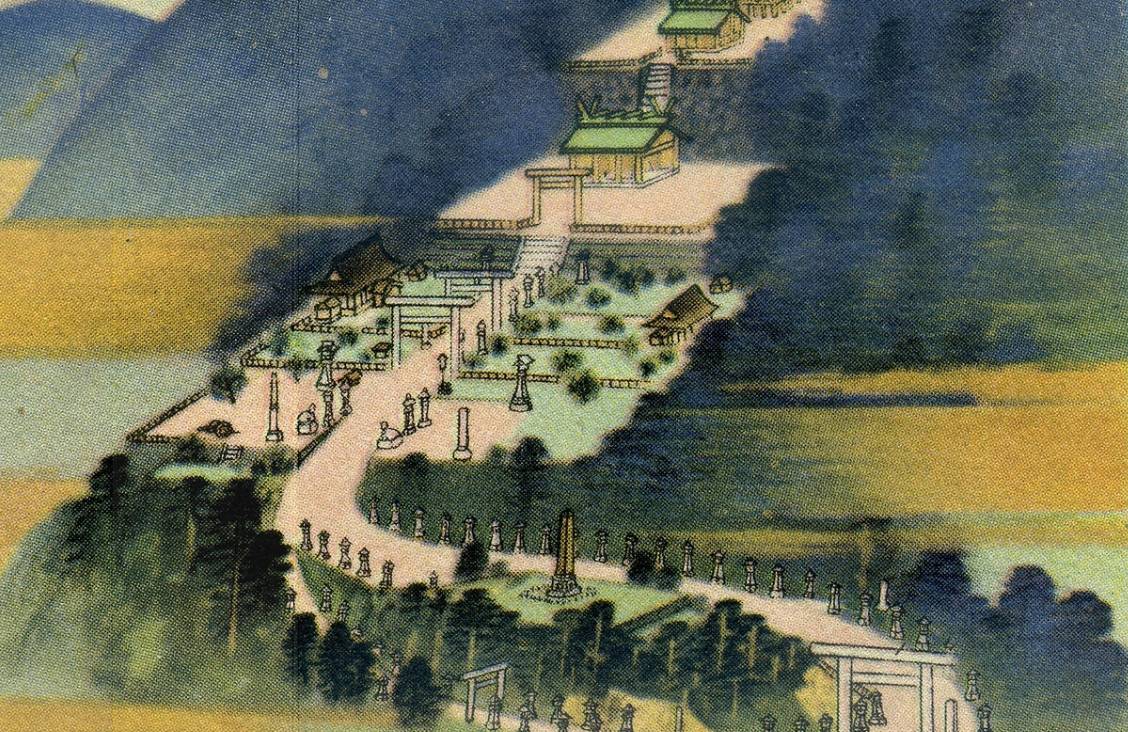
But most amazing of all (hold on to your socks) is that the Grand Hotel in Taipei, that massive red Chinese hilltop structure overlooking the city, conceived by Madame Chiang Kai Shek and renowned for having many interior rooms with no windows, was built on the very site of the Taiwan Grand Shrine, which was the head Shinto temple for the Japanese administration in Taiwan. If you see the picture attached, you can see tori gates standing where Chinese gate structures stand today. To me, that’s amaze-balls; to think the Grand Hotel was originally a large Shinto State Shrine, and which is still laid out like a shrine complex today. If you have ever stayed there, this explains a lot.
But that’s just the history stuff. What has been surprising to me since being a Japan resident is how much fondness and mutual admiration exists today between the Taiwanese and Japanese.
A recent 2019 survey from Travel Voice Japan stated that Taiwan was the most popular travel destination for Japanese tourists—more popular than Hawaii. Taiwan was chosen equally among all age groups, and equally among men and women. And according to the Taiwan News, Japan is the top travel destination for Taiwanese—and has been for some time.
Then there was the 2011 Tohoku earthquake, tsunami, and eventual nuclear meltdown near Fukushima. Taiwanese private individuals donated more than US$252 million in aid, and some Taiwanese politicians led large tours to Japan several months after the disaster to show support. This summer, the favor was returned when Japan donated several million doses of Covid-19 vaccine to Taiwan. A lot of back-and-forth Kumbuya went along with those exchanges.
Also, who can forget the time when China banned all pineapple exports from Taiwan for some reason; Shinzo Abe, the Japanese PM at the time, posted on Twitter how delicious Taiwanese pineapples were, and Japanese companies instantly filled the order shortfall in a show of solidarity. And on the streets of Japan, those Taiwan pineapples sold out immediately despite being 250% more expensive than the regular supermarket offerings.
There was that other time when Emperor Naruhito ascended the throne in 2019, and a Taiwanese trade group gifted the palace with cherry tree (sakura) saplings taken from cherry trees planted in Taiwan by Naruhito’s grandfather, Hirohito, when he visited the island as a prince in 1923. That’s some serious symbolism.
I could go on and on. But, seriously, what’s this cross-national lovefest all about?
It’s hard to say for sure, and there are several theories. There are some who say the current closeness is purely about countering China. Both countries (I mean territories, I mean states, I mean provinces…) face challenges and threats from the mainland, and so the enemy of my enemy is my friend. A Japanese naval base soon to be built on Ishigaki, an island in the Okinawan chain (about 130 miles from the Taiwan coast) is seen as countering China, and the project is enthusiastically endorsed by both Taiwan and the US.
This geopolitical angle may have something to do with it but is certainly not the whole story—about 20% of the story I’d say. It doesn’t explain the enormous mass of inter-personal relationships and commercial connections that underwrite the whole thing.
Others say it’s because of the colonial history. Taiwan was Japan’s first overseas colony, and the Meiji endeavored to make it a model experiment, building schools, railroads, reforming agriculture, and eradicating diseases. These initiatives went over well with the locals. The Out of Formosa theory points out that unlike Korea, which became a colony of Japan despite a strong pre-existing national identity and close ties to China, Taiwan was, at the time, a barbaric “ball of mud” as Ching Dynasty authorities called it. Li Hongzhang, the main Chinese negotiator with Japan at the Treaty of Shimonoseki, confessed that his government never had control of more than 40% of the island, essentially telling his counterparts: “Good luck with that place.” Therefore, Japanese colonial authorities were not fighting against a strong Chinese identity, which in turn meant Japanification could take easy and deep root.
Again, maybe… but I don’t think that’s the whole story either—maybe 30%. If you read the colonial history of Taiwan, there was plenty of resistance and angst, a few massacres here and there, and enough to show that all in colonial Taiwan was not a bed of Japanese chrysanthemums. (At one point, Japan almost sold its colony to France.)
Given numerous conversations on the topic with both Taiwanese and Japanese friends, I think the real reason for today’s mutual affinity has little to do with the past, and much, much more to do with how both sides see their futures: specifically, their shared future in a changing Asia.
They are both deeply traditional, sharing Confucian values, Buddhism, Taoism, and a bunch of other isms that animate just about every street corner. And yet they delight in the modern and have mastered living in this globalized world of science, technology, and commerce. They admire that dexterity in each other. They both are free democracies, with free presses, who pay attention to their people—that’s kinda, you know, refreshing. They both had their Nationalist pasts, with their military parades, overly large boulevards, and pseudo-religious notions of what identity should look like. That ended in tears. They now choose more modest endeavors: craftsmanship, quirkiness, back-alley street food, hot mineral water, and busy intersections exploding with entrepreneurial craziness. They both are hospitable, generous, and making you feel welcome in each other’s back yards—able to share a beer without having to listen to undue sermonizing regarding this topic or that.
Their friendship today is, in my opinion, about who they want to emulate going forward, who they want to share the road with on what promises to be a long, tough schlepp ahead.
Of course, South Korea belongs in this club, and the relationship with Japan there is not nearly so warm and fuzzy. That’s probably because the 50% that is the historical stuff unfolded very differently than in Taiwan, and official relations have always been stormy. However, if you look at tourist numbers, informal person-to-person ties, and commerce, well, the traffic between South Korea and Japan, and South Korea and Taiwan, is not far off the intensity of the Taiwan-Japan bromance.
At the end of the day, I think it comes down to this: as both Taiwan and Japan survey the region, seeing authoritarianism, top-down statism, and a shrinking creative sphere taking hold over there; and gun violence, homelessness, and a bombed-out civic arena wreaking havoc a bit further over there, they then look at each other and say, “you know what, I like what I see in you, I pick that.”
Neither place is perfect—far from it. However, they both are sensible, vibrant, equitable, responsible, and socially balanced soulmates to pick.
And for the record, I pick them too.
Are you taking third wheels?