
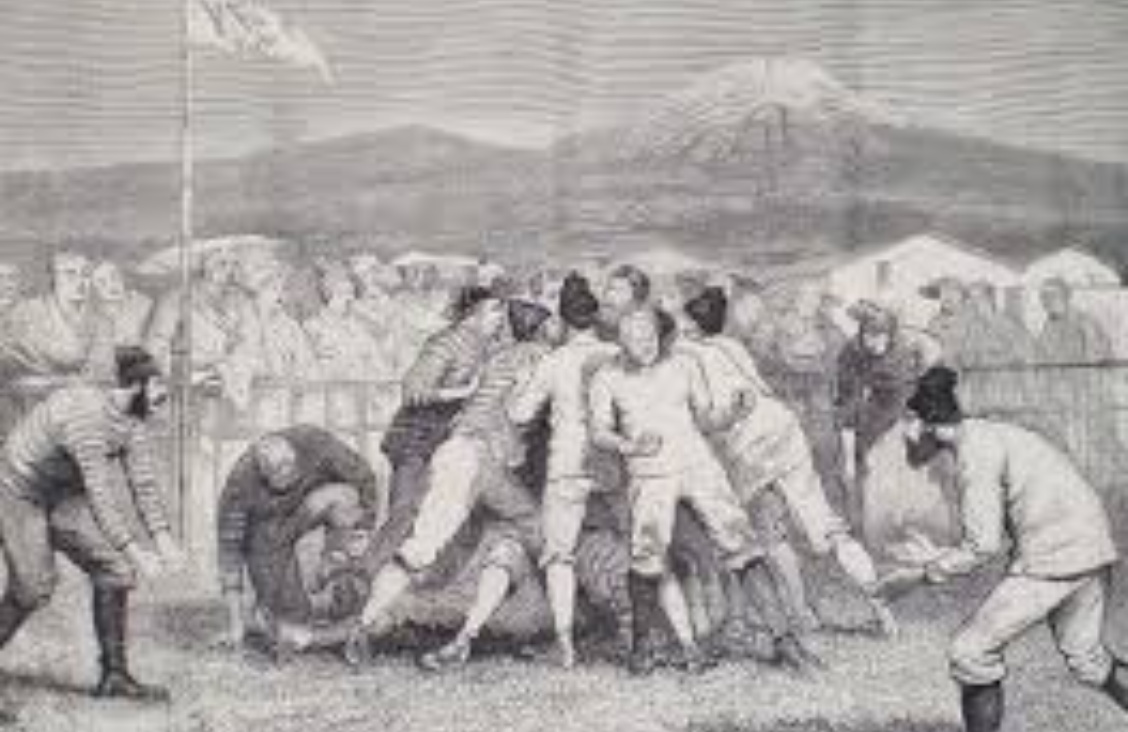
Soon after moving to Japan, I had the tremendous pleasure of watching the 2019 Rugby World Cup live and in person here. I became a rugby convert a decade earlier, thanks to my regular attendance at that annual bacchanalian festival called the Hong Kong Rugby Sevens: a festival which has turned many good basketball, baseball, and American football loving Christians into wild rugby pagans, howling out ‘Sweet Caroline’ after 36 hours of cheering through showers of beer.
At the World Cup I expected great team rugby from the powerhouses, the likes of New Zealand, England, France, and South Africa. But I was surprised by the incredibly strong showing of Japan, ranked number 10 in the world today. The Brave Blossoms made it all the way to the Quarter Finals, beating out Scotland in the Round of 16 in a game my son and I were privileged to watch in person, surrounded by normally stoic old Japanese men weeping aloud with joy. (Japan lost to South Africa in the Quarters.)
Right at about the same time, my family was looking to place our son on a Japanese elementary school baseball team. We were warned not to take the commitment lightly: be prepared for huge hours and military-like team discipline. We opted for the more relaxed expat baseball club down the street. We are soft, I’m afraid to say.
Japan is the best in Asia at soccer, had the third most medals at the 2020 Tokyo Olympics, and has professional baseball, soccer and basketball leagues that rival the US and Europe in terms of excellence and intensity. (You may have heard of this guy named Ohtani?) So, after three years of watching little kids run drills at the local park, I have been wondering, what is going on with Japanese sport? Why does it stand out in a region where participation in sports is generally not encouraged, and where preparing children for exams is usually the only thing that matters?
Turns out it’s an interesting story.
Prior to the Meiji Restoration in 1868, there were no Japanese sports—at least not in the normal sense. There was sumo, which looks like the sport of wrestling but is in fact a religious ritual: a Shinto sport put on for the kami in hopes of securing their blessings. (Thus, all the ritualistic dancing in the beginning.) And then there was military training: disciplines like archery and kendo (swordsmanship) pursued by the Samurai class. Even martial arts like Judo and Karate, while having some ancient origins as forms of military training (mainly imported from China), they did not come together as “sports” or popular disciplines until much later; specifically, at the end of the 19th century.
And believe it or not, that period is very important for all sports—including Japanese sports.
You may be surprised to learn the story begins at Sunday School in Victorian England, within a movement called Muscular Christianity.
Yes, in the mid-19th century, while rural English males were making their way to live in cities and becoming feckless frames of idle paleness in the process, a few school administrators and Sunday School teachers believed the nation needed more air in the lungs, and more red-flushed faces. A movement started at Rugby School (the home of Rugby Football) by the Rev Charles Kingsley, and promoted by the author Thomas Hughes, which stated that muscular and vigorous team sport was essential to moral development: a kind of group sacrament that strengthened a pupil’s body and character and inculcated him with an intuitive knowledge of how to pursue difficult tasks while working as a congregation, united in spirit and purpose. (Aston Villa, Fulham, Everton, and the Bolton Wanders were all Sunday school teams in their beginning—thank you, Wikipedia.)
This idea spread quickly across the churches and schools of the UK, the US, and the Commonwealth, and transformed many mere schoolyard games into the various football codes we have today (rugby, soccer, Gaelic, American grid-iron, Aussie rules, etc). This idea eventually gave birth to the YMCA (Young Man’s Christian Association), and in the US “The Y” gave us basketball and volleyball: the indoor, winter sports that formed my own not-so-muscular, skinny-legged catechism.
The point here is that during the Victorian era, most of the English-speaking world adopted the ideas of Muscular Christianity in their schools, believing that sports were vital to education, a tool that trained both mind and body, and a pursuit that engendered patriotism and a sense of communal purpose. When the Duke of Wellington said in later life that the Battle of Waterloo was won on the playing fields of Eton, he was referring to an early version of this idea: that school games fortified the empire.
What does this have to do with Japan? Well, during the Meiji Restoration, which was unfolding at the same time (a movement which aimed to strengthen Japan by adopting Western institutions) Japan imported large parts of the English school system (have you seen the uniforms?). And with that importation came Muscular Christianity and sport.
Rugby was introduced to Keio University by Professor Edward Bramwell Clarke in 1899, though it was played by foreigners in Yokohama as early as 1866. Baseball was introduced in 1872 by American Horace Wilson at Kaisei Academy. Soccer was thought to have been introduced in 1873 by Archibald Lucius Douglas to the Imperial Japanese Naval Academy. You get the picture: Japanese pupils, taught to play Anglo-American sports in the hopes of “muscularizing” their minds, bodies, and spirits.
At about the same time, those keepers of Samurai military traditions in Japan (koryu bujutsu, 古流武術) no doubt saw this trend and sought to use something more native to achieve similar character-building goals among the youth. And it was at this time that modern martial arts started to take their form (gendai budo, 現代武道). Judo was developed by schoolteacher Kano Jigaro around 1900; and Karate, an Okinawan martial art, made its way to mainland Japan, and particularly to Keio University, in the early 20th century with the aid of various Okinawan masters. What was previously the training regimen of a select few feudal fighters was now offered to all, and especially to students, as a tool to develop the mind and body.
Instead of creating muscular Christians, however, these martial traditions were more individualized in nature and sought to instill a sense of Bushido in young people—Bushido being the code of honor that characterized the Samurai class. You could call it Muscular Buddhism, or Bushido Zen—as the Bushido code had elements of Buddhism in it. Either way, it was martial-looking physical activities aimed primarily at developing the spirit.
“The ultimate aim of Karate lies not in victory or defeat, but in the perfection of the character of its participants.” (Ginchin Funakoshi, founder of Shotokan Karate.) A samurai warrior a few hundred years earlier, while dedicated wholeheartedly to learning his military craft, and bound by a strict code of Bushido honor, would have found this idea strange—as the loser would have been lying dead in a field somewhere. My point is you can certainly see the inspiration of Muscular Christianity converting these Japanese martial arts from ‘military training that makes you a better fighter’, to ‘weaponless military training that makes you a better person’.
As Japanese society began to turn heavily nationalistic in the 1920s and 1930s, this more Bushido approach to sport began to take effect among the imported games as well. Informed by the Empire of Japan, training became more disciplined and intense, more military like, and the intent became not just developing the mind and body through sport, but also instilling a group bushido work ethic in young people which would result in winning and succeeding on behalf of the collective. If Kendo trained a Samurai how to use a sword, Rugby trained young men how to take a field together (maybe someday with guns in hand). No doubt the words of the Duke of Wellington were echoing somewhere in the halls of Japanese power.
Obviously, that does not define Japanese sports today. But the result today is a system that is a mash-up of Muscular Christianity and Bushido. You have an abundance of team sports, and they are played widely at every school (and at a young age), with the recognition that physical activity is a valuable part of education in and of itself. Yet, training can seem very Samurai. Rather than playing a lot of sports, the Japanese athlete is more likely to pick one, and to play it year-round from a young age. Even swimming has a progression of many levels (like belts) where certain aspects of a stroke must be mastered before you go to the next level.
What all this means today is that Japan is good at sport, values sport, and punches above its weight on the global stage. It can also mean that sports training can have a joyless quality to it, with young people burning out at an early age from the intensity.
However, if NHK is right, that approach is changing too, and sports for fun is increasingly the emphasis of schools. The rise of surfing, skiing, and golf; of mature after-work baseball leagues; and the encouragement of young people to participate in a wide variety of sport points to this more well-rounded trend taking root. Either way, you must have a lot of respect for Japan’s sporting traditions, which are just about as old as our traditions in the West.
Next time you see Shohei Ohtani slug one into the bleachers, imagine a Victorian Sunday School teacher and a Samurai high fiving each other in the stands.
He is a descendant of them both.