
Why We Need a Better Industrial Policy
Walk through a town like Ambridge, Pennsylvania or Gary, Indiana, and the narrative seems set in steel: American manufacturing is dead, buried under decades of cheap imports and bad trade deals. But that’s a myth. And like most myths, it obscures the real story.
The truth is: America still makes a lot of steel. About 80 million tons a year, in fact. We’re the world’s third-largest steel producer, behind China and India (World Steel Association, 2023). But what has changed is how many people it takes to make it. In the early 1950s, the steel industry employed over 600,000 American workers. Today, it employs fewer than 140,000 (BLS, 2023).
That drop isn’t because we lost our edge. It’s because we got better and more efficient at making steel. A ton of steel that required 10 man-hours to produce in 1980 now takes just 1.5, thanks to automation, electric arc furnaces, and leaner mini-mills (AISI, 2023).
Imports didn’t kill American steel. What really hurt the American industry was national neglect.
The Starvation of a Giant
If we want American steel to rise again, we don’t need to shield it from the world. We need to feed it with national demand.
The last time we fed that demand at scale was 1956, when President Eisenhower signed the Federal-Aid Highway Act. It was, in his words, “the greatest public works project in history.” It committed $25 billion (about $275 billion today, adjusted for inflation) to build 41,000 miles of interstate highways. That one act required millions of tons of rebar, beams, bridge supports, and overpass frames.
No surprise: steel’s share of GDP peaked right around then. In 1960, it accounted for roughly 2% of the U.S. economy. Today, it’s closer to 0.2% (FRED, 2024). As federal infrastructure spending declined—from nearly 3% of GDP in the 1960s to just 1.3% by 2020 (CBO, 2022)—so too did our industrial competitiveness. We stopped giving our factories anything big to build.

Japan and China Didn’t Steal Jobs—They Built Themselves
While we paused, others pressed forward.
After 1969, when major U.S. infrastructure projects slowed, Japan kicked off its postwar industrial sprint. It poured money into subways, high-speed rail, shipyards, and world-class auto factories. By the 1970s and ’80s, Japan was the world’s top steel exporter. But even at that export peak, 90% of its steel never left the country. It stayed home to build its own infrastructure.
That domestic demand created economies of scale that U.S. steelmakers simply couldn’t match. So, American buyers did what buyers always do: they sourced from where the price and quality lined up best. Back then, it was Japan.
Then came China. When it joined the WTO in 2001, China produced about 150 million tons of steel per year. By 2015, it was pumping out over 800 million tons. Today? Almost a billion—more than half of global output (OECD, 2022).
But here again, most of that steel was not “dumped” abroad: 85-90% of all Chinese steel stayed in China for its own use. It was used to build the China we now see: its cities, ports, power plants, bullet trains, and megabridges. In just four years—between 2009 and 2013—China poured more cement and steel than the U.S. did in the entire 20th century (Smil, 2015).
So no, Japan and China didn’t steal our jobs. They just gave their industries something massive to build, and in building it, became highly efficient industrial behemoths.
Steel Follows Vision: What We Should Build Now
We don’t need to bring back the old steel sector of 1950. We need to give our very modern steel industry a 21st Century mission: some visionary, steel-intensive infrastructure projects. Here’s where we could aim:
1. High-Speed Rail
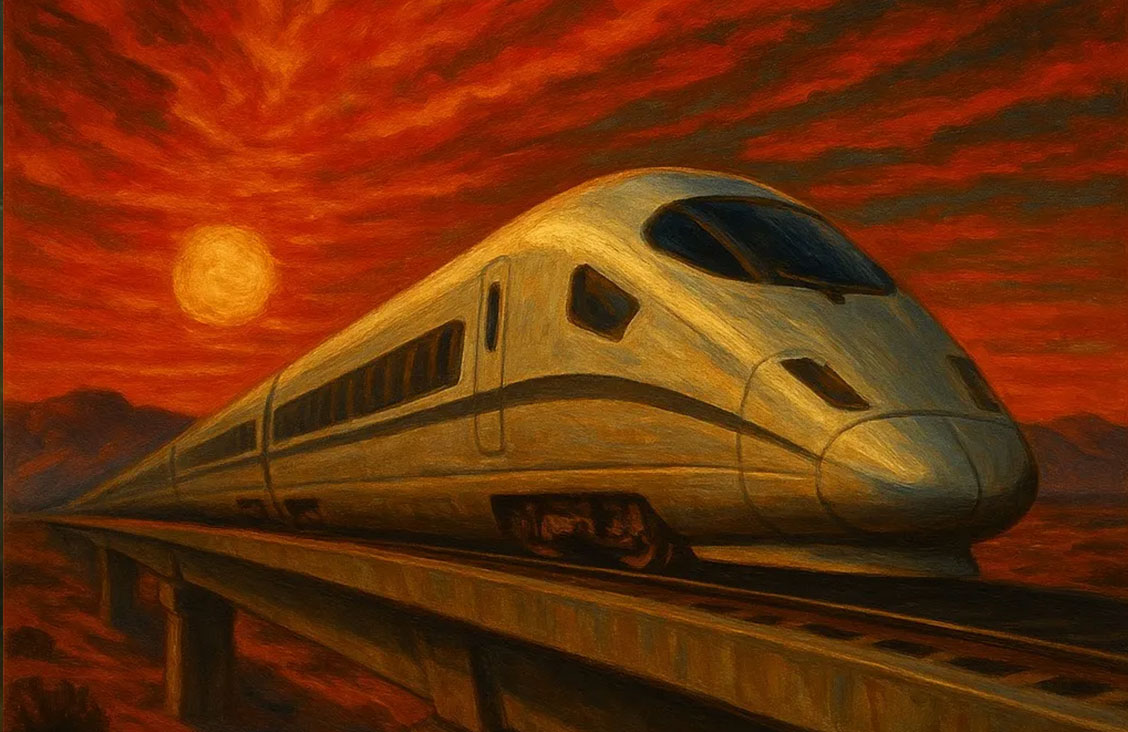
China has 25,000 miles of high-speed rail. We have… 50. And most of that doesn’t even qualify as “high-speed” by global standards. Building true high-speed rail across major U.S. corridors—the Northeast, California, the Texas Triangle—would not only decarbonize travel and connect labor markets, it would eat steel like candy. This is an industry that thrives on volume and certainty. Rail gives it both.
2. National Grid Modernization
Our electrical grid is a fragile, aging quilt. As the economy electrifies—think EVs, heat pumps, solar panels, AI data centers—we need a grid that’s smart, resilient, and regionally connected. That means new transmission lines, buried cables, and load-balancing substations. This isn’t a software problem. It’s steel and copper—and a lot of it (DOE, 2023).
3. Water Systems
We lose six billion gallons of treated water every day due to leaking pipes (EPA, 2023). In cities like Flint, Jackson, and Lahaina, crumbling water infrastructure has already become a public health crisis. Many of our water mains are more than a century old. Fixing this means jobs—pipefitters, welders, engineers—and American materials like ductile iron, steel rebar, and PVC. This is local work.
4. Clean Energy Infrastructure
The energy transition isn’t just about shiny solar panels or elegant wind turbines. It’s about torque tubes, battery enclosures, transmission towers, and hydrogen hubs. China dominates many of these components because it decided early to own the whole supply chain. But the field is still wide open—especially in green hydrogen, long-duration storage, and advanced grid controls. Many of these technologies are sitting in our own university labs. Let’s scale them here.
5. Affordable Housing via Mass Timber and Modular Steel
We have a housing crisis because we have a building crisis. Modular steel frames, cross-laminated timber, and factory-built components can cut both cost and construction time. Countries like Sweden and Japan already use these materials to build beautiful, energy-efficient homes at scale. We can too. Done right, this sector could revive struggling mills and small-town carpentry shops—while finally letting families afford a place to live.
6. Public Transit and Subways
Our cities are suffocating—not just in carbon, but in delay. New York’s subway leaks. Boston’s T is the oldest in the nation and often runs like it. And most U.S. cities have no viable mass transit at all. Investing in subways, light rail, electric buses, and regional hubs would do more than ease congestion. It would build economic mobility—literally. Every $1 billion spent on transit creates about 50,000 jobs (APTA, 2023).
National Nudges, Not National Mandates
A fair question remains: If we build all this, won’t the steel still come from China?
Not if we get smart about how we incentivize production.
The Infrastructure Investment and Jobs Act (IIJA) already includes strong Buy America rules: all iron and steel used in federally funded projects must be melted and poured in the United States. The Inflation Reduction Act (IRA) and CHIPS Act go further, offering tax credits and production bonuses to firms that source domestically. These aren’t bans or mandates. They’re nudges. And they generally work.
Just look at solar. After the IRA passed in 2022, U.S. firms announced over $100 billion in clean energy investments within a year (BloombergNEF, 2023). More than 50 new solar and battery factories were announced, including expansions from First Solar and Qcells. Why the sudden shift? Because the government shouted its intent, and codified it in incentives, targets, and timelines.
I was personally involved in several of those deals. Some of the companies I worked with had never seriously considered U.S. production before. But a long-term government vision, tied fo explicit incentives, changed the strategic calculations.
Steel is no different. Lay out a 10-year infrastructure agenda, and you’ll see steelmakers reinvest, modernize, and hire.
This Was Our Model First
What super-charged the industrial backbones of Japan and China was, in the beginning, learned from us.
We used to build like this. The Erie Canal, the Hoover Dam, Silicon Valley microchips, and the Apollo Program—none of these happened by accident. They were the product of public ambition paired with private ingenuity.
But somewhere along the way, we forgot the formula. We began to think of “industrial policy” as something foreign and socialist. As if planning ahead were un-American.
We don’t need five-year plans. But we could use some well-articulated five-year commitments: clear, credible demand signals that let our industries invest without fearing the rug will be pulled out from under them the next election cycle. (Unfortunately, this administration seems allergic to certainty.)
Let’s stop pretending that tariffs will bring factories back. They won’t.
National demand will.
Let’s get back in the game.