
Today, America’s relationship with China is built on fear.
This fear has reshaped our foreign policy. We see China not as a competitor, but as a civilizational rival: a threat to our very identity. From this belief flows every tariff, embargo, and export control. Our trade strategy has become a blunt weapon: block China’s growth before it swallows ours; starve their industries before they challenge ours; wall off their students and scientists before they surpass us.
This framing is misguided and has led us astray. It begins with a false assumption: that China’s only acceptable future is to become a mirror image of the United States.
I’m sorry to say, China was never going to be our twin. Even if the Chinese Communist Party fell tomorrow, whatever replaced it would still be shaped by centuries of political tradition very different from our own.
Western democracy grew from specific historical soil: Locke and Jefferson, parliaments battling kings, the Protestant Reformation’s focus on individual conscience. China’s soil is older and distinct: Confucius and Mencius pursuing harmony through hierarchy, and Legalist’s thinkers like Han Feizi emphasizing laws, administrative technique and state power. To paint in broad strokes, where our tradition elevates seeking truth through debate, theirs has often elevated mediation in pursuit of harmony. Where we champion individual liberty, they have historically prioritized collective stability.
This doesn’t excuse China’s abuses, and there are plenty of them. But neither impulse—liberty or stability—is inherently good or evil. They are different answers to the same question: How do you keep a society from tearing itself apart?
These different societal priorities aren’t accidental; they are products of deeply ingrained history. Scholars call this path dependence: the idea that historical experiences shape institutions in ways that endure for centuries. As Francis Fukuyama observes in The Origins of Political Order, China developed the first modern centralized bureaucratic state more than two millennia ago, creating expectations about governance that economic growth alone cannot erase. China was the first society to establish a rational meritocratic bureaucracy by the Qin dynasty; an achievement that preceded Europe’s state-building by nearly two thousand years.
That history, and it’s shaping effect on Chinese society, cannot be easily erased.
Over the past century, America has repeatedly tried to “convert” China. We’ve cheered revolutionaries who promised democracy. Later, we bet that free trade would create a middle class demanding freedom. Each time, we were disappointed. Why? Because we were measuring success by our reflection in their mirror.
By framing China as a civilizational rival, we lock ourselves into a cycle of fear and misunderstanding. And if we’re not careful, that cycle could lead us into a conflict neither side truly wants.
A Different Vision
But there’s another way to see this moment.
China doesn’t have to be our twin to be our partner. It doesn’t need to look like America to be part of a shared future. Instead, it can stand as a separate pillar, different in form, but connected in function.
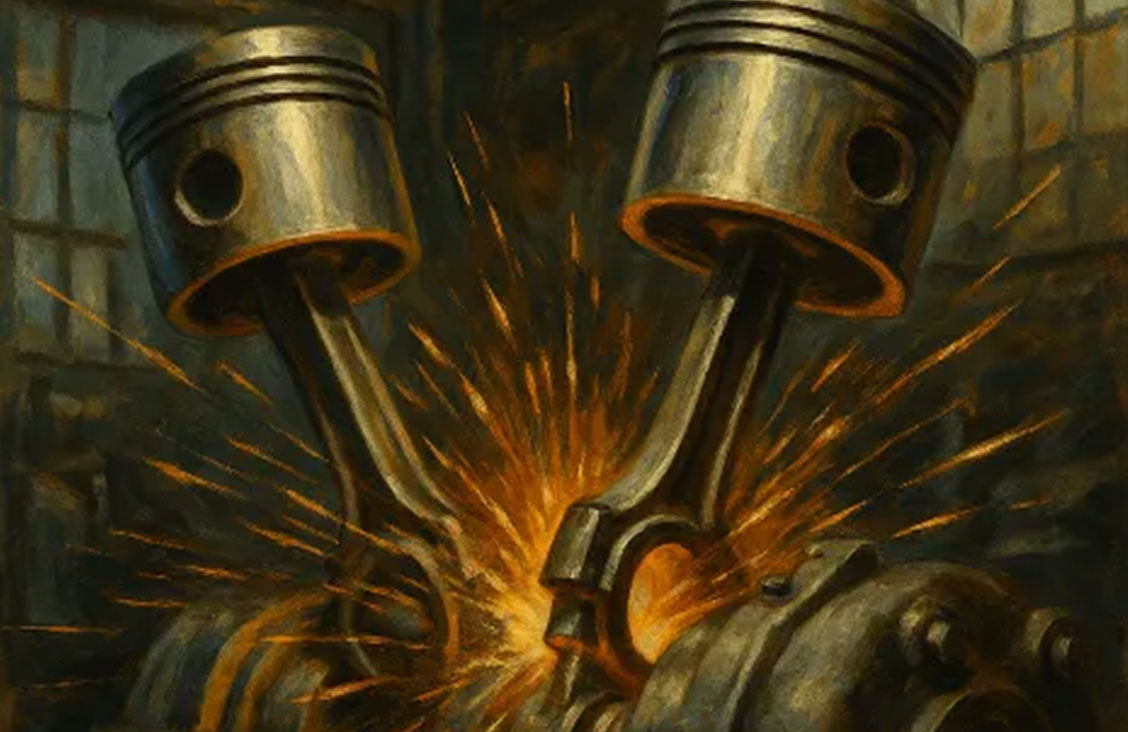
Imagine the global economy as a great engine with two pistons.
On one side is the United States and its network of allies: chaotic, inventive, endlessly improvising. This is the side that invents airplanes, microchips, lifesaving drugs, and apps no one knew they needed until they couldn’t live without them. Think of the Wright brothers tinkering in a bicycle shop, or Steve Jobs in a garage, or a graduate student at MIT stumbling on an AI breakthrough at two in the morning.
On the other side is China: vast, coordinated, disciplined in ways the West simply cannot be. This is the side that takes sparks of innovation and scales them up in world-changing ways. Where we improvise, they organize. Where we prototype, they mass-produce.
These impulses aren’t opposites; they can be complementary. Together, they form a rhythm, a back-and-forth that has powered decades of growth, and should power decades more, if we are smart enough to get out of the way.
Consider solar energy.
In the 1950s, American scientists pioneered the first solar cells, laying the groundwork for what was then a niche technology. For decades, solar remained expensive—more an environmentalist’s dream than a practical energy source.
Then Chinese factories began producing at scale. Between 2010 and 2020, the global price of solar panels dropped by 82 percent, making clean energy affordable for communities from California to Kenya. The cost of utility-scale solar electricity fell from $0.378 per kilowatt-hour to just $0.068, a transformation that neither side could have achieved alone. American labs lit the spark; Chinese manufacturing fanned it into a worldwide flame.
This dynamic isn’t limited to solar. It’s how smartphones became affordable for billions. It’s how lifesaving drugs move from U.S. patents to global production lines. It’s how electric vehicles evolved from quirky prototypes in Silicon Valley to mainstream products rolling off assembly lines in Shanghai and Detroit. In 2024, China produced approximately 12 million electric vehicles—over 70 percent of the world’s total EV production—driving down costs and accelerating the global transition to clean transportation.
And yet, instead of harnessing this synergy, we’re tearing the engine apart.
The Cost of Fear
Tariffs and embargoes slow our own growth and weaken our ability to solve shared challenges like climate change and food security.
In 2024, U.S.-China trade reached approximately $659 billion. This represents a relationship that has reshaped the American economy, sometimes painfully, but on balance, beneficially.
Yes, when Chinese imports surged after 2001, certain American communities were devastated. Research estimates that somewhere between 550,000 and 2 million manufacturing jobs were lost to Chinese import competition—the so-called “China Shock.” Textile mills in the Carolinas, furniture factories in the South, computer manufacturing in California and Massachusetts. These losses were real, concentrated, and impossible to ignore.
But the data tells a more complete story. Between 2000 and 2007, increased trade with China boosted the purchasing power of the average American household by approximately $1,500 annually through lower prices. Meanwhile, U.S. exports to China supported over one million American jobs: farmers in Iowa, aerospace workers in Seattle, university staff educating Chinese students, engineers designing semiconductors. When economists calculated the overall impact, the consumer benefits outweighed job displacement by more than 10 to 1.
None of this means ignoring China’s bad behavior—or our own.
There are areas where competition must remain fierce, even adversarial. Certain sectors truly are matters of national security. We need to be clear-eyed about this, but also precise about what genuinely qualifies.
The Department of Defense has identified specific vulnerabilities: critical minerals like antimony, gallium, germanium, tungsten, and tellurium are essential for manufacturing military equipment. A recent analysis found that 78 percent of U.S. weapon systems rely on components containing these five minerals, for which China dominates global processing. Advanced semiconductors for defense applications, certain pharmaceuticals, and essential infrastructure components represent similar chokeholds.
But here’s the crucial point: these genuinely security-sensitive sectors represent a tiny fraction of our total economic relationship with China. The vast majority of our $659 billion annual trade involves consumer goods, agricultural products, industrial equipment, and technologies that pose no plausible security threat. We’re talking about televisions and toys, soybeans and steel, machinery and medical supplies.
When we paint all of Chinese trade with the same national security brush, we’re being stupid. We’re treating garden furniture the same way we treat gallium semiconductors. We’re applying military-grade restrictions to Walmart-grade problems.
Our goal should be to work with China as it is: negotiating where we can, defending where we must, and recognizing that mutual benefit is possible even between rivals.
Trade is one of the few tools that can accomplish this. It’s not just about goods moving across oceans. It’s about people interacting with people: engineers, entrepreneurs, designers, students. Every shipment of iPhones or airplane parts represents thousands of conversations, contracts, and moments of trust built over time.
There are your real diplomats of peace.
The alternative is bleak. A fractured world economy won’t just hurt U.S. consumers or Chinese manufacturers. It will slow our collective response to the greatest challenges of this century.
Imagine trying to build a global pandemic warning system without Chinese data. Fighting climate change while cutting off the world’s largest producer of clean energy technology—China now produces over 75 percent of global lithium-ion batteries and nearly 80 percent of solar modules. Developing AI without access to the largest pool of STEM graduates on Earth.
It’s like trying to fight a wildfire with the largest nearby reservoir of water closed for access.
The U.S. and China can be two complimentary pistons in the global engine of economic growth. They don’t need to look alike, but they do need to move in concert. If they seize up, the engine stalls—and everyone loses.
This vision isn’t naïve. It’s harder than simply slapping on tariffs and declaring victory. It requires courage: the courage to distinguish between competition and conflict, between healthy rivalry and existential fear, between the 2 percent of trade that genuinely threatens our security and the 98 percent that doesn’t.
China will never be America’s twin. But it doesn’t need to be our enemy.
We might start by recognizing that two different pistons, moving in a coordinated rhythm, generate far more power than one piston trying to tear the other out of the machine.
That’s called self-sabotage.
Suggested Reading
On China’s Political Development and Path Dependence:
- Francis Fukuyama, The Origins of Political Order: From Prehuman Times to the French Revolution (2011)
- Francis Fukuyama, Political Order and Political Decay: From the Industrial Revolution to the Globalization of Democracy (2014)
- Francis Fukuyama, “Reflections on Chinese Governance,” Journal of Chinese Governance (2016)
On U.S.-China Trade Statistics:
- U.S. Trade Representative, “The People’s Republic of China” country page (https://ustr.gov)
- U.S.-China Business Council, “US Exports to China” annual reports (https://www.uschina.org)
On the China Shock and Manufacturing Job Losses:
- David Autor, David Dorn, and Gordon Hanson, “The China Shock: Learning from Labor-Market Adjustment to Large Changes in Trade,” Annual Review of Economics (2016)
On Consumer Benefits from Trade:
- Xavier Jaravel and Erick Sager, “What Are the Price Effects of Trade? Evidence from the U.S. and Implications for Quantitative Trade Models,” LSE Business Review (2019)
- Lorenzo Caliendo, Maximiliano Dvorkin, and Fernando Parro, “Trade and Labor Market Dynamics: General Equilibrium Analysis of the China Trade Shock,” Econometrica (2019)
On Critical Minerals and National Security:
- Center for Strategic and International Studies (CSIS), “China Imposes Its Most Stringent Critical Minerals Export Restrictions Yet” (2024)
- Govini, “Rock to Rocket: Critical Minerals and the Trade War for National Security” (2025)
On Solar Energy Cost Reductions:
- International Renewable Energy Agency (IRENA), “Renewable Power Generation Costs” annual reports
- National Renewable Energy Laboratory (NREL), “U.S. Solar Photovoltaic System and Energy Storage Cost Benchmark” reports
On Electric Vehicle Manufacturing:
- International Energy Agency (IEA), Global EV Outlook annual reports
- Information Technology and Innovation Foundation (ITIF), “How Innovative Is China in the Electric Vehicle and Battery Industries?” (2024)