
By Timothy Brantingham
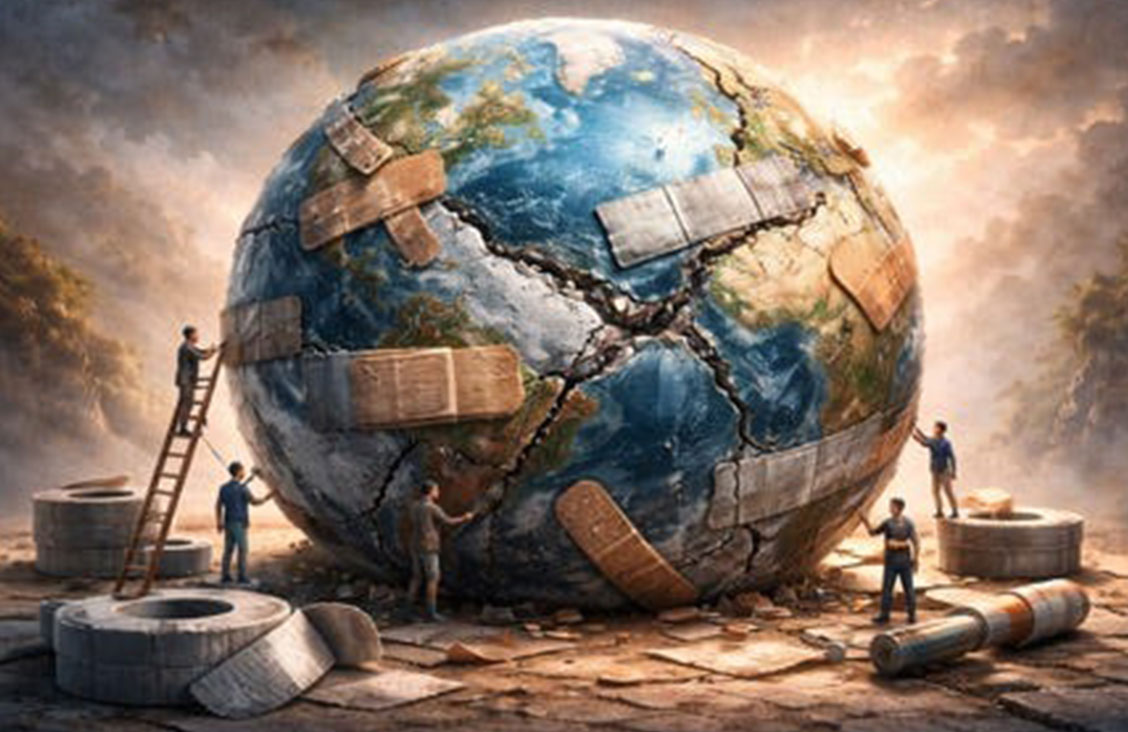
Howard Lutnick stood at Davos last month and declared to the Bloomberg TV crew sitting around him: “globalization has failed.”
It was one sentence.
And with that sentence the United States Secretary of Commerce rendered thirty years of my life’s work illegitimate. And not just mine. With three words, he dismissed seventy-five years of business plans written by American companies. Seventy-five years of supply chains built by American entrepreneurs. Seventy-five years of alliances, of mutually shared prosperity, of contracts signed under a consensus of international law.
Painfully, he is not alone in this verdict. Bernie Sanders has been saying for years that the global economy is an economic model developed by the economic elite to benefit the economic elite. Everyone else lost, he claims.
Donald Trump says we got robbed through free and open trade. Trump and Sanders agree on almost nothing in this world except this: people like me—the so-called globalists—are a problem.
The Right thinks I sold out American workers by shipping their jobs to China. The Left thinks I enabled corporate exploitation. Both sides have concluded, from their different angles, that the work I did was at best naive and at worst a betrayal of the American Dream.
I’ve been sitting with that bipartisan accusation for a while.
I’m not afraid of the policy arguments. I know my accusers’ arguments and they are weak. I have been a proponent of globalized free trade for decades and I will continue to be.
What I am sitting with is something more personal: the realization that the thing I gave my professional life to, the thing I believed in, has been declared dead by the very country that trained and commissioned me to pursue it.
And not by fringe voices. By the Secretary of Commerce. By the President. By senators on both sides of the aisle.
That is a strange heartbreak to sit with.
China Hand to China Heel
I used to lead most cocktail conversations with my China experience. It was the most interesting thing about me: born in Taiwan to a missionary family, four generations of connection to China, thirty years building trade relationships across Asia. I wore it openly. It was my credential, my identity, the one thing that made me useful in a room.
Now, I’m inclined to hide that past.
I’m no longer the China Hand—I’ve become a China Heel.
Even so, I can’t hide what I’ve seen. I have thirty years of factory grease under my fingernails, thirty years of baijiu jet-fueling through my liver, and thirty years of wrestling with national prejudices in both countries. I watched a billion people climb out of poverty in real time. I was there when factory workers in Suzhou sent money home to build the first concrete houses their families had ever owned. I was there when villages in India got electricity because export revenue funded infrastructure. I watched the single largest poverty-reduction event in human history unfold within the span of my own career.
And now I’m supposed to be ashamed of that.
Sorry—but I’m not.
The Tribe of the Displaced
In the fog of disappointment I started calling old friends. Former colleagues from the trade world. Supply chain people who had quietly scrubbed their LinkedIn profiles. A diplomat who spent twenty years in Southeast Asia and now can’t get a conversation going in Washington. An old USAID hand who was fired when Elon Musk shut the agency down. A missionary friend who spent a decade in Central Africa building schools and clinics, only to find American churches more interested in Christian nationalism these days than in international outreach.
Every conversation had the same undertone. Not anger, exactly, but a growing sense of spiritual homelessness.
None of us were woke bureaucrats. None were corporate villains. We were just ordinary American believers. We believed that America’s greatest export was not soybeans or software but the idea that open societies work: that democracy, transparency, and international cooperation produced better outcomes for more people than the alternatives.
We believed America was a City on a Hill, a watchtower with a torch burning at its summit, lighting the path upward through the fog for anyone willing to make the climb.
We spent years in language study. We spent our careers in malarial climates and conflict zones, on factory floors, and in embassy conference rooms, doing the unglamorous, decades-long work of building trust across borders. And now the country we served has decided to toss us over the cliff and use the watchtower for kindling.
None of these friends feel represented by the current conversation. None of them like the Right. None of them like the Left. All of them are ashamed by ally bullying, and dismayed that the old establishment has gone totally into hiding—like a bunch of cowards. And the space we used to occupy, the space between nations, between cultures, between competing interests, has been clear-cut and declared a no man’s land.
That is where I find myself. And I suspect it is where many of you find yourselves too.
But the verdict our accusers have handed down is missing a whole lotta evidence.
We Were There
Between 1990 and 2019, global extreme poverty fell from roughly 36 percent of the world’s population to under 9 percent. I watched that happen from factory floors in Asia.
American consumers benefited too: trade with China alone reduced prices for U.S. households by hundreds of dollars a year, savings that fell disproportionately to lower-income families. Global supply chains helped keep inflation low for decades, stretching paychecks further than they otherwise would have gone. American companies gained access to vast new markets, selling everything from aircraft and corn to software and entertainment. The technology sector that now defines American economic leadership—from Silicon Valley to Austin—was built on globally integrated production and talent flows. American tech almost entirely goes away without those international inputs.
That was trade doing its work. But trade was only one thread in a much larger fabric.
American-funded health programs helped eradicate smallpox and nearly eradicated polio. PEPFAR, launched under George W. Bush, provided antiretroviral treatment to millions living with HIV across sub-Saharan Africa, saving an estimated 25 million lives. My friend who spent a decade building clinics in Central Africa was part of that.
American education trained generations of leaders across the developing world. Fulbright scholars and exchange students built a global network of people who understood democracy not as an abstraction but as something they had experienced firsthand. Many carried those values home. Some built institutions. A few changed their countries.
And the alliance system that America designed after 1945 kept the great powers from going to war with each other for seventy years. Not perfectly. Not without proxy conflicts and moral compromises. But the broad arc was unmistakable: more peace, more prosperity, more people living under rules-based systems than at any point in human history.
Trade lifted hundreds of millions out of poverty. American generosity cured diseases and built schools. American alliances kept the peace. None of it was perfect. But it was all very, very real.
And now it is coming apart.
A Gathering Place
I know what I built mattered. I know what my friends in Central America, Southern Africa, and Eastern Europe built mattered.
But I am not launching this platform to win an argument. I am launching it because I am tired of hiding my face at that cocktail party. I imagine some of you are too.
There is a whole tribe of people who spent their lives building connections across borders and who now feel homeless in a world that has turned inward. Diplomats, traders, missionaries, engineers, educators, development workers, Third Culture Kids. People who lived between nations and believed that the space “in-between” was where the most important work happened.
Every time America has tried retreat, from Smoot-Hawley in the 1930s to America First today, it has ended badly. The old global board game had problems, and some of the rules needed rewriting—for sure. But you do not win a chess match by flipping the board and giving everyone around you the middle finger. That is the strategy of the current administration.
It’s not working.
When critics question the value of lives lived across borders, they are questioning the moral legitimacy of everything I was raised to believe was right. I was taught that the person standing in front of you matters more than the border lines on a map. I thought building bridges across those man-made lines was the right thing to do. I thought it was the Christian thing to do: an extension of the nation-blind brotherly love that four generations of my family practiced, from Nanjing to Madhya Pradesh to Taipei.
I still believe that. And I refuse to be quiet about it.
That is what The In-Betweenist is for. For those who lived their lives from the margins of everywhere. If you want to help me illuminate what global connection looks like, come join me on this Substack. We are not dishing out kumbaya. We are telling our American neighbors what actually happened, what Americans Abroad actually accomplished, and why our nation is better off as a result.
I am not writing from a think tank or a policy institute. I am writing for myself, for my friends, and from a broad network of lived international experience.
This platform is for people who have done similar work and refuse to be told it was worthless.
Globalization was working. Not perfectly, not always for everyone, and not without costs that we failed to address.
But it was working.
And right now, it needs witnesses.