

Recent economic reports show a strange split screen.
On one side: In November 2025, consumer and light industrial goods imports to the USA declined measurably, with imports from China down 17% year-over-year. Combined with that was news that spending on manufacturing construction in the US hit $214 billion (annualized rate) as companies announced planned investments in American production capacity.
On the other side: The U.S. trade deficit nearly doubled to $56.8 billion—a 94.6% jump from October, the largest percentage increase since 1992.
How can both trends be happening at the same time?
The Washington consensus assumes one trend is good (less stuff from China) while the other is bad (the trade deficit still growing). But in fact, both trends are bad.
And we should be worried as hell.
Declining Imports = Domestic Industrial Strain
I know a small manufacturer in the Midwest who imports copper bus bars from China: the critical conductors that move electricity through power distribution equipment. The equipment itself is designed and assembled in America by American workers in an American factory. The ultimate buyers are American.
But the bus bars—the most expensive components—come from China. They come from China because no domestic supplier can provide these bus bars at the same scale or price.
This is not an edge case. It’s the standard operating reality of American manufacturing in power equipment, EV infrastructure, grid modernization, and data centers.
Chinese bus bars are cheap and high quality not because China has better copper mines (China actually produces only 8% of the world’s mined copper and imports 60% of global copper ore) but because China has built massive refining and manufacturing capacity.
China didn’t build copper dominance just to export to the U.S. It built it to wire itself up to the modern age. Over the last two decades, China built electrical infrastructure at a scale no other nation has matched. China’s power output expanded nearly fivefold since 2005, and today has an electrical grid bigger than the US and Europe combined.
But our minders in Washington are convinced China makes copper products for one reason only: that is, to dump them on us, hollow out our economy, and—you know—replace us as a civilization.
Therefore, they have imposed tariffs. Copper faces a 50% Section 232 tariff plus the blanket 20% on all Chinese imports. Total hit: 70%.
So, for our Midwestern electrical equipment manufacturer, his most expensive input is now nearly twice the price. He has no domestic supply at anywhere near the same price or scale. He can buy from Chile, but they also face tariffs and don’t have China’s refining infrastructure or component manufacturing capacity.
He can eat the cost and bleed out slowly, raise prices and lose contracts, or shut the doors entirely. There is some relief in that all his competitors also have to raise prices. But even there, the winner will be defined by who can bleed out for the longest period of time without dying. Hardly the manufacturing renaissance we were promised.
Now let’s look at that “reduction in imports.” What that actually means is thousands of American businesses are facing these same three realities. They are making less money, shrinking their market share, and/or going out of business. Tariffs are reducing their commercial viability with the same efficiency as they the reduce Chinese imports.
Since tariffs ramped up in April 2025, U.S. manufacturing has lost 59,000 jobs. The Institute for Supply Management’s manufacturing index spent most of 2025 in contraction territory. In their November survey, one machinery executive reported: “The tariff mess has utterly stopped sales globally and domestically. Everyone is on pause. Orders have collapsed.”
So yes: fewer Chinese bus bars are coming in. Also: less American electrical equipment is being made, supporting fewer American jobs, and businesses are hemorrhaging margins or shutting down entirely.
Is that really a win?
The Exemption Lottery
Here’s where it gets darker. There is an exclusion process. Companies can apply to the U.S. Trade Representative for relief from specific tariffs. It requires lawyers, detailed applications running pages long for each product category, and months of back-and-forth.
During Trump’s first term, less than 15% of applications were approved. A 2024 study found that companies with Republican political contributions had markedly higher approval rates than those without.
My friend with the copper bus bars? He can’t afford a K Street law firm. He can’t spend months navigating an opaque bureaucratic process with a sub-15% approval rate. He doesn’t have a lobbying budget or a relationship with the administration.
He just pays.
But Ford, GM, and Stellantis? In March 2025, they secured explicit exemptions on auto parts, many of which include copper components and electrical systems. But for smaller automotive suppliers and equipment manufacturers, like my friend, importing similar components…. sorry, no such luck.
Same components. Same country of origin. But radically different outcomes, based purely on company size and political access.
… And we wonder why your Average Joe is perpetually pissed off.
The Manufacturing Investment Mirage
Now, how about that manufacturing investment boom? Headlines trumpet $214 billion in annual manufacturing construction spending and companies announcing over $500 billion in planned investments.
Sounds impressive… until you look at what’s actually driving it.
Answer? Your tax dollars. Not the tariffs.
First, nearly all that manufacturing is coming from one sector: the AI infrastructure boom. It’s not coming from the Midwestern electrical equipment manufacturer trying to build his own bus bar plant. No way. He can’t afford it, and if he were to try, he would end up with a product vastly more expensive than the China version—even with tariffs.
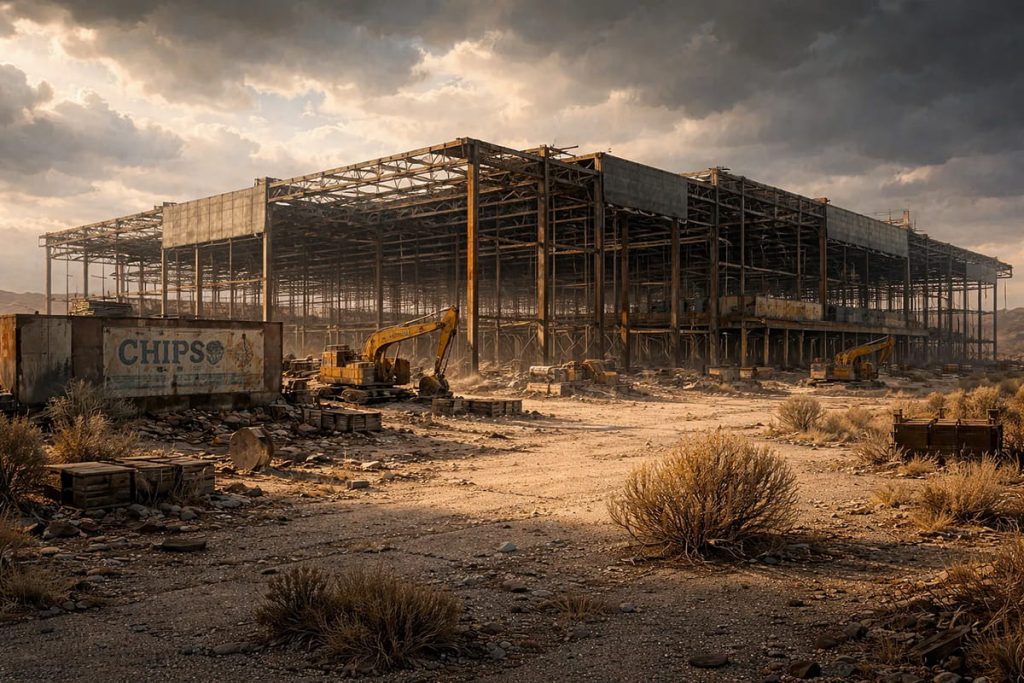
No, the so-called manufacturing boom is almost entirely related to subsidies under the CHIPS Act. This act subsidizes domestic production of semiconductors—fabrication, assembly, testing, and advanced packaging—along with the materials and manufacturing equipment used to make chips. It provides grants for building fabs that produce everything from leading-edge logic chips to mature-node semiconductors, plus a 25% investment tax credit for manufacturing equipment.
That’s where the manufacturing investment is happening. And it is about as far away from a free market as you can get.
A Peterson Institute analysis found that over 80% of these investment projects by value wouldn’t have happened without CHIPS Act subsidies. Sometimes there is an argument for industrial policy like this. But let’s stop pretending tariffs or newfound patriotism caused this to happen. These aren’t market-driven investments responding to competitive dynamics. They’re subsidy-driven announcements responding to government checks.
To the extent non-CHIPS manufacturing is reshoring, it’s also subsidy-driven—from the Inflation Reduction Act’s 45x tax credits for solar components to state and local incentives for battery plants. Without government subsidy checks, none of this reshoring happens.
When you’re building industry on subsidy, protected by tariffs, you are not building a competitive manufacturing base. We’re building wards of the state: companies dependent on federal handouts to justify investments they wouldn’t otherwise make.
Those handouts come from the very same taxpayers getting hit with tariffs on the goods they’re buying today. And yes, this contributes to inflation.
The Ballooning Trade Deficit: Taxing Tomorrow’s Infrastructure
So, if all this manufacturing is supposed to be underway, why is our trade deficit ballooning? That answer is because none of that manufacturing capacity exists yet.
Right now, there is unprecedented investment in the AI infrastructure of tomorrow, but hardly any is able to deliver product today. As you’ve read, every large language model requires massive GPU clusters, advanced logic chips, server racks, power electronics, transformers, cooling systems, and globally sourced precision components. Almost none of this is made in the USA—at least not at scale—and when it does finally get made in the USA (in about 10 years), the AI infrastructure will already have been built.
The CHIPS Act Timing Problem
The standard MAGA hawk defense of tariffs goes something like this: Short-term pain is necessary for long-term sovereignty. Accept higher costs now to force domestic capacity into existence. Once the fabs are built, tariffs come off and we win.
But that assumes we can build capacity fast enough. (We can’t.) And that also assumes that when we start delivering those chips they’ll still be relevant. (Very likely, they will not. The most advanced chips will still be made in Taiwan and South Korea.)
TSMC’s Arizona fabs—originally scheduled for 2024 and 2025—are now delayed to 2028. Intel postponed its Ohio facilities from 2025 to 2027-2028. Samsung’s Texas production slipped from 2024 to 2026. Forty percent of major CHIPS Act projects are facing delays, with even greater struggles in finding skilled labor.
Even if everything goes right from here on out (don’t count on it), meaningful domestic output arrives late in the decade.
The AI infrastructure race will already have been run.
The unfortunate result will be that America’s AI infrastructure will end up being the world’s most expensive in the world, built on imported, highly tariffed inputs, with American capability arriving a decade too late. I can’t wait to read the Harvard Business School case studies on this catastrophe when my kids hit graduate school.
Take Nvidia’s latest GB200 systems: the cutting-edge AI servers powering the next generation of large language models. A single rack costs over $3 million and requires advanced chips from Taiwan, high-bandwidth memory from South Korea, precision cooling systems from specialized suppliers across Asia. Tariffs add hundreds of thousands of dollars per rack before a single line of code runs.
That cost doesn’t disappear. It shows up as slower model training, fewer clusters deployed, and less experimentation per dollar.
America’s data center competitor in Singapore, however, will be built without any tariff burden whatsoever.
That’s what you call an “own goal.”
The Bottom Line
Here’s the reality: Tariffs are shrinking America’s organically grown industrial base. They’re taxing the infrastructure we need to build for tomorrow. And the subsidies meant to replace what tariffs destroy are creating wards of the state: companies dependent on federal handouts for investments they’d never make on competitive merit alone.
Did you know America’s sugar industry has been protected by tariffs for 240 years? Did you know American sugar became so expensive that Coke and Pepsi switched to high-fructose corn syrup thirty years ago? That’s what perpetual protection looks like: an industry that never becomes competitive, requiring state support generation after generation.
Is that what we want for our semiconductors? For our AI infrastructure? For the industries that will define the next century?
I hope not. That’s a capital transfer from future competitiveness to fund present-day political theater.
And our kids will get stiffed with the bill.