

As I understand it, global trade is out of whack. And the hawks in Washington are going to fix it with tariffs. Or they’re going to negotiate better deals with tariffs. Or they’re going to go bowling with tariffs. Honestly, it’s hard to tell—because multiple strategic narratives have emerged, all equally incomprehensible.
But if I follow the main talking points from the cable news circuit, the logic seems to be this: Free trade has become unfair, and China, in particular, is ripping us off. The arguments boil down to four key claims:
- Free trade strengthens the Chinese Communist Party, and the Chinese State, at our expense;
- Trade imbalances hollow out U.S. industry and drive up the value of the dollar, making American exports less competitive;
- The loss of manufacturing is a national security threat; and
- The China trade is killing the American working class.
All four of these claims are various degrees of wrong. With the last being closest to true, and the first being the most laugh-out-loud wrong.
I’ll tackle each of these on Substack over the coming month. But for now, let’s just start with the first, and most wrong, claim: that free trade strengthens the Chinese Communist Party at our expense.
Peter Navarro, Senior Counselor to the President for Trade and Manufacturing, encapsulated this sentiment when he said:
“[China] is a country run by a dictatorial Communist Party with a mercantilist economy owned, controlled and operated by the CCP for the purpose of plundering America and the rest of the world.”
— Coalition for a Prosperous America, 2020
What Mr. Navarro describes is very Borg-like indeed: an authoritarian collective absorbing everything in its path. But unfortunately, he needs a brief refresher in Chinese history, because he has it completely upside down.
China’s so-called “opening up” did not begin in some polished Politburo room in Beijing. It started in the desperate villages of Anhui and Sichuan, after tens of millions had perished under disastrous central planning schemes like the Great Leap Forward, and after the turmoil of the Cultural Revolution. Local farmers, ignoring Party mandates, divided up Party co-op land into family plots and started selling surplus produce on the black market. They thrived, not because the CCP helped them, but because local cadres, exhausted and broke, turned a blind eye.
By the early 1980s, these same farmers had become one of the most prosperous groups in China. Their bottom-up success—known as the Household Responsibility System—was just economic common sense: grow what you want, sell what you can. Otherwise known as free trade to you and me.
Deng Xiaoping, ever pragmatic, didn’t invent this system. But he co-opted it, branded it as national policy, and called it reform. Let’s be totally clear: the Party didn’t lead the opening of China. The party was dragged to the nation’s gate and the keys forced into its hands by its own people.
That dynamic has never really changed.
Modern China’s rise has been driven by what can be paraphrased as China’s economic Periphery. (Jean Oi, Thomas Heberer, and David Zweig) These are the farmers, workers, business leaders, and shop keepers who sit well under the Chinese Communist Party but are the ones doing the real work of the local economy. They are family and clan oriented more than they are state-oriented. They will accommodate the state, but not if the state compromises the well-being of their family clan.
Thus, the farmers of Anhui… “OK, CCP, enough is enough; we are taking matters into our own hands.”
This is not a new tension in Chinese history. For millennia, China has cycled between strong Confucian-inspired central authority and bursts of localized innovation, creativity, and even rebellion. When China experienced its dynastic peaks, it was because the nation allowed space for a vibrant merchant class, for trade, and for local entrepreneurial energy. When China lurched towards decline, it was usually because the emperors feared the power of the Periphery, the pollution of trade, and felt inclined to shut it all down.
(See: Ming Dynasty, retreat to neo-Confucianism, closing down of Zheng He’s maritime trade routes.)
Might that all sound familiar?
What I am saying is that since China’s opening, the Periphery has been leading the charge. The Periphery emphatically choses global trade in general, and American trade in particular. They send their kids to U.S. schools; they keep close tabs on our news, music and movies.
And the CCP, the Center, has spent the last 40 years trying to keep up. By the early 2000s, it had largely abandoned Marxist rhetoric and rebranded itself as a provider of roads, rail, and capital. “Socialism with Chinese Characteristics” was really just Adam Smith’s public works doctrine, but with a few red banners thrown in.
That’s not to say the CCP was (or is) impotent. Leaning into its Leninist strengths, it has built jaw-dropping infrastructure in almost no time at all. By restricting capital flows, it has taken the savings of its economic Periphery and used them to build perhaps the world’s largest army and navy. It commands nuclear weapons, its own Space Force, and a global presence we must take seriously.
The Party very much wants to be the face of China’s success. It wants to embody the vision Navarro imagines: an authoritarian machine controlling the entire national enterprise. But that vision is fiction. The Party is still scrambling to find its role in a country impatient with its stodginess.
Yes, they built remarkable infrastructure: high-speed rail, gleaming airports, superhighways connecting remote villages to megacities. At one point, China poured more concrete in two years than the U.S. did in the entire 20th century. They looked at their engineering capacity and said, “Hey, we do this really well.” And they weren’t wrong.
But then they kept pouring, and kept pouring, and kept pouring….
Local governments borrowed like mad to build stadiums no one used, apartment blocks no one lived in, and highways leading to nowhere. The result? Overcapacity, debt-ridden municipalities, and an economy now sinking into what looks like a decades-long, debt-fueled deflationary fart.
And yes, they propped up strategic sectors like solar with massive subsidies. Beijing wanted to dominate the green energy supply chain by sheer scale and state support. It sounded good on paper. China now produces more than 80% of the world’s solar panels.
But if you follow the money, things get murky. Between trillions of yuan in subsidies, ultra-low interest loans, and zombie firms that never turned a profit, the Chinese solar boom begins to look shaky. One recent estimate puts total investment in solar, batteries and electric cars at over US$1 trillion. It’s still unclear whether the country has made any real economic return on this master plan.
In both cases, the Chinese state flexed its Leninist capacity to mobilize resources at scale. But scale is not success. And the bills are coming due.
The economic Periphery in China has been watching this with concern.
Hawks in Washington see China as a monolithic, malevolent avatar, kicking up the global marketplace and dragging its people behind it. But the opposite is in fact true. The CCP is like a hydra with many factions, interests, even ideologies. The Chinese state is a mashup of central and regional power bases. The Chinese people are as varied as you and me.
But make no mistake: The real power in China lies in the economic Periphery—in the people—and it is they who are dragging the Party behind them.
Xi Jinping knows this. And it makes him deeply uncomfortable.
He, like the Xuande Emperor of the late Ming dynasty, no doubt wants to bring power back into the Center. That’s why he occasionally clamps down on business leaders, censors tech entrepreneurs, and tries to reassert ideological control. But these are not moves of strength. They are desperate attempts to regain relevance; to pull back into the center what global trade has pushed out to the economic Periphery.
It’s a battle he cannot win unless he completely dismantles the Periphery, and the Periphery just won’t stand for that.
Unless, of course, your trade partner starts imposing ridiculous tariffs on you.
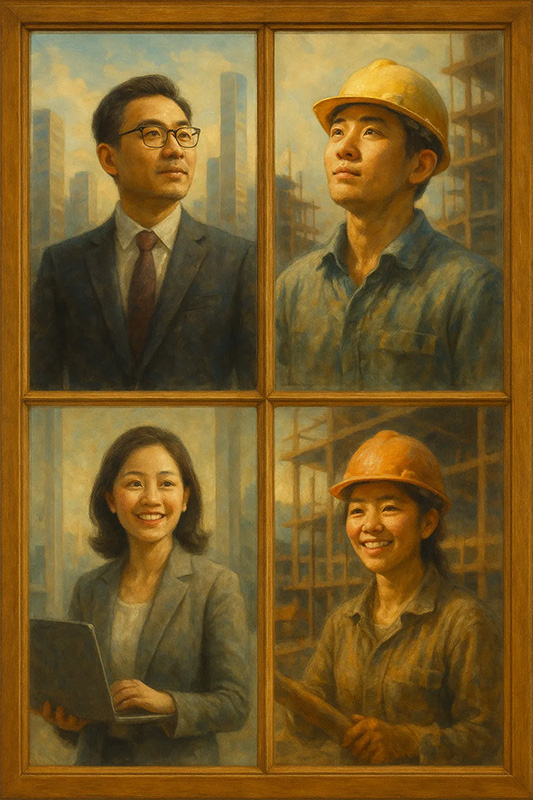
Power to the Periphery
So, let’s stop pretending that tariffs are a surgical tool aimed at the authoritarian heart of the Chinese state. They’re a blunt instrument, and they hurt the wrong people.
They don’t hit the censors, the PLA, or the surveillance cameras. They hit the factory owner who risked his life savings to sell to American clients. They hit the student in Nanjing who studied English five hours a day for five years. They hit the startup founder in Chengdu trying to license U.S. software.
In short, they punish the people—the Periphery—who were the ones that reached out to us in the first place.
We’ve all seen what people-led trade can do.
Take Taiwan. When I was growing up there, it was under KMT martial law—diplomatically isolated and bracing for war. And yet, U.S. and Japanese businesses came pouring in. Part of it was the postwar Pax Americana, sure. But more than that, the Taiwanese people were tired of being pawns in someone else’s ideological battles. They wanted prosperity, not politics.
By the 1990s, Taiwan had become one of America’s most trusted trading partners. Today, it ranks as the 8th-largest export market for the U.S., ahead of France and Italy. That closeness wasn’t built by bureaucrats or central planners. It was built by millions of entrepreneurs—people like Mr. Lin in New Taipei City—who jumped up and down and said, “Pick me! Give me the order!”
Same with Hong Kong. In 1983, after the handover to China was announced, panic set in. There was a run on the currency, massive capital outflows, and the property market froze. In response, the Hong Kong Monetary Authority pegged the Hong Kong dollar to the U.S. dollar at 7.80 to 1, backed by full reserves.
They didn’t peg it to the yuan. They didn’t peg it to the pound. Why? Because the Hong Kong government wanted to send a signal—to the world, and to its own people—that its economic future was really tied to the United States, not to China.
That was 40 years ago. The peg is still in place.
Ladies and Gentlemen, the same dynamic—not so quietly at all—has been playing out across China.
The entrepreneurial Periphery—that real engine of growth—walked away from the Party line long ago. They want contracts, not slogans. Markets, not manifestos. They have aligned with us, quietly, and in good faith.
Tariffs break that faith.
They tell our most natural allies in China: you’re on your own. They punish those who embraced engagement, and hand the CCP the perfect talking point: “See? You never could trust the Americans.”
I have friends in China who are beginning to believe them.
Free and open trade, contrary to what Mr Navarro says, empowers the economic Periphery in China and forces moderation on the CCP. Containment, decoupling, and confrontation does the opposite: it emboldens the Center, silences the edges, and gives some geriatric cadre, high on nationalism and insulin, a now unfettered path for his aggression.
Trade engagement isn’t appeasement. It’s a great strategy. And it was working.
If we listen to Mr Navarro now, and walk away, we don’t just lose market share. We lose one of the most potent economic forces the world has ever known: the Chinese people.
I cannot state strongly enough what a massive loss that would be.
**************
If Mr Navarro reads my post (he won’t) he might respond, “Hey, Brantingham, I have no problem with free trade, I have a problem with skewed trade. The Chinese government has gamed the system and taken advantage of the USA through naïve twerps like you.”
Did China game the system? Did we also? Am I a schmuck?
We’ll get into that next time.