
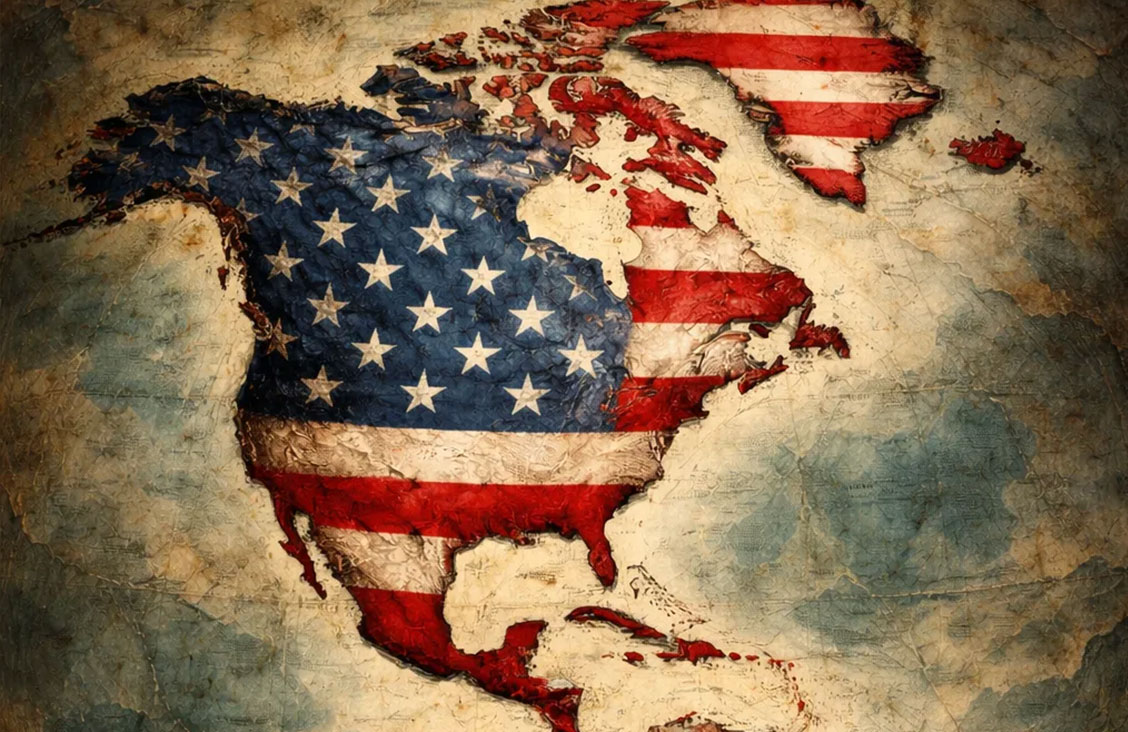
In 2019, Donald Trump first floated the idea of buying Greenland. When Denmark politely declined, he dropped it. But in recent weeks, now serving his second term as President and wanting to juice his ratings, he has revived the proposal with renewed aggression. His advisors have begun talking about Greenland as a “strategic necessity.” The language has shifted from purchase to something closer to annexation. Officials have refused to rule out military force.
Then there’s the rhetoric about seizing the Panama Canal to keep out the Chinese, jokes about Canada as the 51st state (which are not quite jokes), and the now very real spectacle of American Delta Forces extracting a foreign President from a compound in Venezuela, however awful he may have been.
Stephen Miller went on CNN and explained the administration’s worldview, arguing that “international niceties” are for the naïve, and that the world is ultimately governed by “strength,” “force,” and “power”—what he called “the iron laws of the world that have existed since the beginning of time.”
The administration calls it a Trump weave on the Monroe Doctrine—or the Donroe Doctrine. I call it the Dotard Doctrine, borrowing a wonderful Trump descriptor from Kim Jong-un.
Here’s what the Dotard Doctrine means: The Western Hemisphere belongs to America. Other people’s sovereignty is a massive ‘meh’. Dominance trumps diplomacy. International law is for ferries and pansies. If the United States wants something, even if she is unwilling or unsuspecting, we will just take it—you know, grab her by the…. (ok, I won’t go there).
It is imperialism without competence. Hegemony without vision. Gospel-less gangster culture trying to present itself as something grand and Napoleonic.
But, ladies and gentlemen, it is not. These folks are severely and stupidly misguided. We have tried all this before.
Repeatedly.
And it has failed every single time.
Imperial Costs
Let me give you some numbers.
The Bay of Pigs (1961): The U.S. backed 1,500 Cuban exiles to overthrow Fidel Castro. The invasion failed within 72 hours. Castro’s position strengthened. Cuba locked into a Soviet orbit for the next 30 years. The geopolitical objective—keeping Cuba out of Soviet hands—achieved the exact opposite result.
Vietnam: Hundreds of billions of dollars. 58,000 Americans dead. Millions of Vietnamese dead. We lost the war. The dominoes we were protecting in that region? Most of them aligned with us anyway—not because we fought in Vietnam—but because we offered them the trade, development aid, and security partnerships.
Guatemala (1954), Chile (1973), Nicaragua (1980s): U.S.-backed coups and proxy wars that installed strongmen, destabilized regions, and created generational hatred for all things American. The cost? Billions in covert operations and military aid. The result? Fragile regimes that collapsed or turned against us the moment we stopped propping them up.
The last great power to experiment with this was Britain. And it went bankrupt. World War II left Britain with debt approaching 250 percent of GDP, its foreign assets had to be sold off, its gold reserves depleted, and its economy became dependent on American credit. Maintaining a global military presence, colonial administrations, and repeated regional military interventions proved fiscally impossible in a democratic society that also demanded housing, healthcare, and dignity at home.
The British Empire didn’t collapse in a blaze of glory—it was quietly liquidated, piece by piece, because the books no longer worked. Great Britian eventually (and rightly) chose the welfare of their people on the home islands over the grand, but empty, vision of empire.
Do the Dotard Doctrinaires really want to go there and wager all domestic credibility? Power projection is not free. Dominance is not self-financing. Every cent spent on propping up Venezuela or occupying Greenland is a cent not spent on the living viability of the American citizen.
Soft Power is Way Cheaper.
Remember The Marshall Plan?
From 1948 to 1952, the United States spent $13 billion rebuilding Western Europe—roughly $130 billion in today’s dollars.
No occupation. No puppet generalissimos. Just strong economic aid.
We funded reconstruction. We rebuilt factories, roads, ports, power grids. We stabilized currencies. We sent engineers and bankers.
Western Europe recovered faster than anyone predicted. Political stability followed economic stability. Communist parties lost traction. Western European nations became America’s strongest, most reliable allies for the next 75 years.
We spent $130 billion and got permanent continental alignment.
Or consider the Berlin Airlift (1948-49). When the Soviets blockaded West Berlin, the U.S. responded with 278,000 flights delivering 2.3 million tons of supplies. Cost: $224-500 million. We didn’t fire a shot. We flew in food and coal for 11 months straight.
The Soviets lifted the blockade, their own imperial ambitions humiliated. West Berlin stayed free. The airlift became a symbol of American resolve that echoed for decades.
I Watched This Happen
In the 1980s, 1990s, and 2000s I was on the ground in Taiwan, South Korea, Southeast Asia, and eventually China. I wasn’t there as a diplomat or a soldier. I was there as a missionary kid, and then as a trader, building supply chains, watching American companies and Asian factories figure out how to work together.
While Taiwan and South Korea had a US miliary presence that was the result of Cold War conflict, what made them true allies and prosperous partners was not the guns we had there. It was the trade and development assistance we opened up. We created real mutual benefit, which led to a real desire to align with our priorities.
By the 1980s, when China opened, the same pattern repeated. My siblings walked into factories where managers were desperate for American orders. Thirty years of Cold War rhetoric and sanctioned trade did nothing to change China. But about 36 months of sending American purchase orders, ships, and dollars turned China completely inside out.
About ten years ago, I was buying steel fabrications from a factory outside Hanoi. The manager was a kind man, maybe in his sixties, who told me with a twinkle in his eye that the factory had been founded in the 1970s with Chinese help to manufacture weapons for the war against South Vietnam and the Americans.
“As a young man, I hated all things American,” he said.
But after the war ended, he became disillusioned with the communist government. He wanted a better life. He learned English partly by watching bootleg American movies. When relations normalized in the 1990s, he was one of the few workers in this factory with English good enough to do international business. He was promoted.
Now? Most of his customers are American. One son was studying in Singapore. Another in the UK. All sustained by American purchase orders.
He smiled. “What a strange circle, hey?”
That’s what soft power looks like. A man who once built weapons to kill Americans now builds his family’s future on open American commerce and mutual respect.
That’s what I watched happen over the thirty years of my career.
And that is what the Dotard Doctrine is dismantling—utterly and completely—in just a few stupid tweets.
It is absolutely devastating to watch.
The Arithmetic of Peace
Let’s be precise about costs.
State Department/Diplomatic Corp: The entire U.S. diplomatic apparatus—the State Department, the Foreign Service, embassies, consulates, negotiators, political and economic officers, passport and visa services — operates on roughly $55–60 billion a year, or well under 1% of the federal budget. That is a rounding error in a $6-trillion government.
Yet that small slice keeps embassies open in nearly 190 countries, negotiates basing and access rights, defuses conflicts before they become wars, processes millions of visas and passports, and gets Americans out alive when crises erupt abroad. Dollar for dollar, diplomacy is the cheapest national-security investment the United States makes — and the first one imperial fantasists are eager to torch.
Peace Corps: Cost per volunteer per year: roughly $40-50,000 all-in. Total FY2024 budget was under $500 million, or 0.01% of the federal budget. Volunteers teach English, build infrastructure, provide medical care. They create personal connections that last lifetimes. Many host-country nationals who work with Peace Corps volunteers go on to become leaders; leaders who remember America fondly.
USAID: U.S. foreign aid in FY 2023 was $71.9 billion, about 1.2% of total federal spending. Yet it maintains relationships, builds goodwill, and advances American interests in nearly every country on earth. Were there some flimsy programs? Sure. Did it deserve to be cut in whole? Absolutely not.
Compare that to military intervention:
Afghanistan and Iraq (2001-2021): Over $8 trillion when you include long-term veteran care and interest on borrowed funds. Twenty years. Thousands of American dead. Hundreds of thousands of local deaths. Both countries collapsed the moment we left. Afghanistan couldn’t even stand 72 hours.
And that’s just looking at the ledger for the last 25 years.
Soft power delivers way more at a fraction of the cost. Hard power is ruinously expensive and rarely delivers a win.
Coercion: The Foreign Policy of the Incompetent
It’s not surprising this administration is falling back on imperial instincts. Coercion is what you do when you have nothing better to offer.
When you radiate no warmth, no competence, no vision that might attract allies by choice, you threaten. When you cannot inspire, you intimidate. When you have no moral language that travels, you rely on leverage.
It is the politics of the unlikable. The way of the bully who mistakes dominance for strength because respect is unavailable to him.
During the Cold War, the U.S. built a network of 55+ formal alliances. Those alliances were not maintained through constant coercion. They were maintained through the very “international niceties” that Stephen Miller maligns: things like shared interests, economic integration, good faith negotiation, and the projected values of American culture—as loud and inconsistent as it can be.
American movies did more to align the world with U.S. interests than any gunboat. Agricultural aid and medical programs built more goodwill than any sponsored coup.
The current administration appears to know none of this history. Stephen Miller declares that “strength, force, and power” are “the iron laws of the world that have existed since the beginning of time.”
But he’s dead wrong. The actual iron law is this: imperial control is expensive, cooperation is cheap, and coercion generates resistance that outlasts the coercer.
We learned this in Vietnam. We learned it in Iraq. We learned it in Afghanistan. We learned it in every single Cold War intervention that blew up in our faces.
And now we’re going to learn it again, apparently, because this administration is too arrogant or too ignorant to read the receipts.
The Global In-Betweenist
I personally can’t take it anymore. That is why, in a few weeks, I am launching an online platform called The Global In-Betweenist.
My life has been lived entirely between cultures, and it is a deep pain to see my leaders spit on my life experience. I helped build supply chains and cross-cultural friendships. I negotiated with Chinese factory managers and love nothing more than having a boozy dinner with my wife’s Japanese family in Tokyo. I watched cultural and national alignment happen in real time. And I know—I know!—that it works.
And I am just one of thousands—maybe tens of thousands—of Americans who did that exact same work. Diplomats, doctors, engineers, missionaries, teachers, traders, and translators who patiently built and passionately maintained American influence around the world.
We are being spoken over by people who have never done that work. Who don’t even know what that work looks like. Whose entire foreign policy education appears to be derived from playing Call of Duty in their mother’s basement.
I can’t help but to speak my piece, however tiny my voice may be. I hope you will consider joining me.
The Global In-Betweenist aims to provide facts, figures, history, and logic sharp enough to cut through the imperialist, nationalistic bullshit currently masquerading as real strategy.
This platform will say clearly:
· Cooperation was not weakness.
· Trade was not betrayal.
· Alliances were not naïve charity.
· Soft power was not a liberal fantasy.
They were the evolved results of centuries of political trial and error. They worked. They were working. They built more. And what they built lasted longer.
Help Me
If you spent years in the Foreign Service building relationships the administration now wants to torch—I need your stories.
If you built businesses across borders and watched trade create alignment—I need your examples.
If you taught English in rural villages, ran NGOs or mission schools, trained health workers, or just lived between cultures long enough to understand that partnership can work—I need your voice.
If you have data on what development aid actually costs versus what military intervention delivers—send it.
If you watched soft power work and can document it with numbers, names, and consequences—share it.
The Dotard Doctrine is about to spend billions—maybe trillions—repeating mistakes we already paid for. We will alienate allies. We will generate resistance. We will create generational instability that will require more intervention, which will create more instability, which will require more intervention.
Or we can, together, remember what worked, and remind our fellow citizens.
Please join me and let’s turn our sorrowed groans into a powerful, well-informed slap across the dotard’s ignorant lips.
I’m done grieving.
Write “interested” in the comments below, and I will find a way to reach you personally.
“Blessed are the Peacemakers, for they shall be called the children of God.”
Matthew 5:9